I had the chance to present at a couple of great natural bodybuilding events over the past several weeks.
The first was at Layne Norton's VIP Camp, where my talk was on the Lessons Learned during my journey as a natural bodybuilder. It included a discussion of why failure is crucial to progressing (both in life and in bodybuilding). It also focused heavily on 4 things I think Champions DO during the journey, and 2 that they DON'T. It got a lot of good feedback from the attendees...thanks Layne for having me out! I love this camp because it features people in academia doing actual work relevant to bodybuilders...and oh yeah I got to hang out with World Champion powerlifters as well.
The second was John Gorman and Cliff Wilson's Physique Summit. My talk there was on "Physiological Changes During Natural Bodybuilding Contest Preparation" and walked through the things I look for as I diet down into contest shape. It was an awesome environment, with over 150 attendees learning from some of the best in the business. Thanks guys for an amazing event!
Friday, August 19, 2016
Friday, February 19, 2016
Upcoming Appearances
Here is a list of some bodybuilding-related events that I will be participating in over the next few months:
1) Mar 4 - 6: Arnold Classic, Columbus, Ohio. I will be at the Core Nutritionals booth.
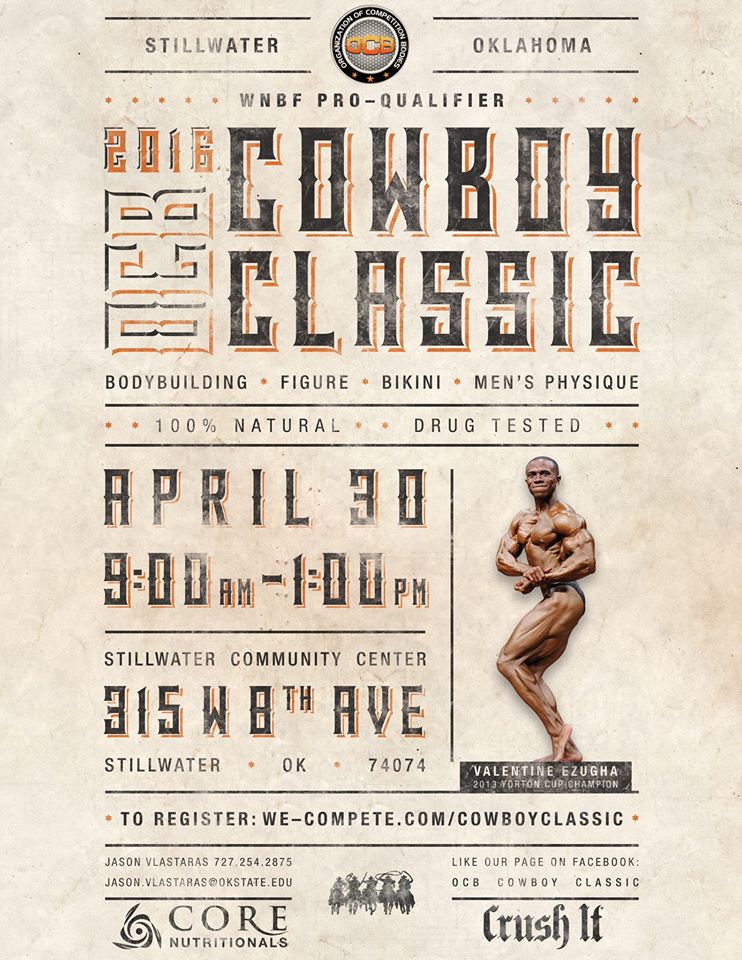
2) Apr 30: OCB Cowboy Classic, Stillwater, OK. I will be serving as head judge for this competition - now a WNBF pro qualifier! My good friend (and fellow Yorton Cup Champion) Valentine Ezugha will be judging as well. You can find out more information here
3) Aug 4-7: Layne Norton's VIP Camp, Tampa, FL. Always an incredible time with some of the most amazing minds in natural bodybuilding! The science-based lectures are phenomenal.
4) Aug 12-13: The Physique Summit, Springfield, MO. Put on by John Gorman and Cliff Wilson, 2 of the top natural bodybuilding coaches in the world. "Where Scientific Research Meets Real Life Application."
Friday, January 22, 2016
Post-competition Interviews
I have had the chance to do several interviews with people from the natural bodybuilding community after my overall wins at both the IFPA Yorton Cup and WNBF Worlds. I talk about various aspects of my prep (including almost giving up after developing serious osteoarthritis in my right knee). I also delve into how I managed to mesh this prep with other aspects of my life - including helping to raise twin 1-year olds and a 4 year old - while maintaining my productivity as a professor. Thanks to Jeff Nippard, John Bosse, Anthony Monetti, and Anthony Bevilacqua!
Interview with Jeff Nippard & Robin Gallant: 61 minutes
Interview with Inside Natural Bodybuilding (John Bosse): 51 minutes
Interview with Anthony Monetti (WNBF Pro and yes, the guy from MTV!): 45 minutes

Interview with New York Muscle Radio (Anthony Bevilacqua): 40 minutes via Skype so you can see my awesome office at OSU!
Interview with Jeff Nippard & Robin Gallant: 61 minutes
Interview with Inside Natural Bodybuilding (John Bosse): 51 minutes
Interview with Anthony Monetti (WNBF Pro and yes, the guy from MTV!): 45 minutes
Interview with New York Muscle Radio (Anthony Bevilacqua): 40 minutes via Skype so you can see my awesome office at OSU!
Tuesday, December 1, 2015
FINALLY
2015 was without question my best year in natural bodybuilding. I returned to the stage, competing in arguably the two best federations in natural bodybuilding (the IFPA and WNBF), and was able to capture World Overall titles in both organizations. I became the first person to win both World Pro Overall titles in natural BBing history. I will have a lot more to say about this contest season when I finally find time to update my website (a full-on revision is in the works), but for now THANK YOU to all my supporters. This has been nearly a decade in the making for me, with a lot of setbacks and disappointments along the way.
Below you can find a video of the Yorton Cup Overall, where I defeated the Heavyweight champ Shevon Cunningham (avenging my 2013 1-point loss at WNBF Worlds). I was proud that I was able to obtain 5 of the 7 judge's votes in this decision.
Here is also a video of the WNBF Worlds Overall, where I defeated the Middleweight champ Cleveland Thomas and Heavyweight champ Shevon Cunningham. Cleveland was the 2014 WNBF Overall Pro Champ and Shevon was the 2013 WNBF Overall Pro Champ, so to be able to claim a decision over two great champions made the win that much better. Again, I was able to garner 5 of the 7 votes (with Cleveland and Shevon each getting a vote).
Friday, May 15, 2015
Squat / Deadlift Highlights
After recovering from a groin strain in 2014, I had some success building back some strength in both my squat and deadlift. Below you can find a video of some off-season testing right around the time I began my prep for the 2015 contest season.
Saturday, August 30, 2014
Not Squatting or Deadlifting Stinks
My offseason training was progressing nicely under the supervision of Dr. Zourdos, as I was working up to doubles in the mid-500 range for conventional deadlifts (I haven't pulled sumo since the contest with Layne - see post below) and finally getting some good reps with over 4 plates for squats. Unfortunately, however, something felt "off" during a squat rep about a month ago and although I trained around it for a while, I ended up pulling my groin fairly extensively during a heavy deadlift attempt several weeks ago. At that point I promised myself I wouldn't squat or deadlift again until everything was completely healed.
Training without heavy squats or deadlifts stinks.
I have been doing my best to do a "traditional" bodybuilding routine since then, but it's simply not as enjoyable.
Training without heavy squats or deadlifts stinks.
I have been doing my best to do a "traditional" bodybuilding routine since then, but it's simply not as enjoyable.
Sunday, June 15, 2014
2014 Update
This update is long overdue. Since competing at Worlds in November 2013, my focus has primarily been on family and work. About 10 weeks prior to the show, Jill and I found out that she was pregnant once again – with twins this time! Our excitement was soon tempered when we found out that the twins shared an amniotic sac – a condition known as a mono-mono pregnancy (this occurs in about 1 out of every 30,000 pregnancies). Umbilical cord entanglement was likely, and mortality rates were scarily high (most recent research put them between 20-50%). Jill was required to stay under constant monitoring at a tertiary hospital for the last 10 weeks of the pregnancy, literally only getting out of bed for 15 minutes a day. This was a very trying time for our family, but we received constant support from our families, co-workers, and friends (including the natural bodybuilding community).
We were blessed to welcome Remy and Paige Whitacre into the world on March 14. After a relatively short 9-day stay in the Neonatal Intensive Care Unity, they came home and joined our family. Aside from some minor sleep deprivation, we are all doing great! The twins are growing nicely and Sidney is enjoying being a big sister.
On the bodybuilding front, OSU was proud to welcome my friend Dr. Layne Norton to campus in April for a series of seminars and some friendly competition. Layne spoke on a variety of topics, including “Fitness Facts and Fallacies” and “Optimal Training Routines.” The two of us also competed in a 3x bodyweight deadlift contest, which was watched by over 150 people at the OSU gym:
Layne ended up pulling 651 lbs for 7 reps weighing 217 lbs, which was pretty amazing to watch. I managed 533 for 8 reps at 177. It was a great time and definitely one of the highlights of my lifting “career.”
I knew even before the 2013 Worlds that I would not be competing in 2014. With the additions to our family and everything that we had been through, going through the rigors of a contest prep was simply not very high on my priority list. I am enjoying my training (and the amount of food I get to eat!) with the goal of returning to the stage in 2015 or 2016. I am still working with Dr. Mike Zourdos on my training split, and though I am currently training around a couple of injuries I am happy with how the off-season is progressing. My training partner Jason Vlastaras just won his IFPA pro card, and given the new “opening up” of the WNBF we hope to compete together at a few shows over the next couple of years.
We were blessed to welcome Remy and Paige Whitacre into the world on March 14. After a relatively short 9-day stay in the Neonatal Intensive Care Unity, they came home and joined our family. Aside from some minor sleep deprivation, we are all doing great! The twins are growing nicely and Sidney is enjoying being a big sister.
On the bodybuilding front, OSU was proud to welcome my friend Dr. Layne Norton to campus in April for a series of seminars and some friendly competition. Layne spoke on a variety of topics, including “Fitness Facts and Fallacies” and “Optimal Training Routines.” The two of us also competed in a 3x bodyweight deadlift contest, which was watched by over 150 people at the OSU gym:
Layne ended up pulling 651 lbs for 7 reps weighing 217 lbs, which was pretty amazing to watch. I managed 533 for 8 reps at 177. It was a great time and definitely one of the highlights of my lifting “career.”
I knew even before the 2013 Worlds that I would not be competing in 2014. With the additions to our family and everything that we had been through, going through the rigors of a contest prep was simply not very high on my priority list. I am enjoying my training (and the amount of food I get to eat!) with the goal of returning to the stage in 2015 or 2016. I am still working with Dr. Mike Zourdos on my training split, and though I am currently training around a couple of injuries I am happy with how the off-season is progressing. My training partner Jason Vlastaras just won his IFPA pro card, and given the new “opening up” of the WNBF we hope to compete together at a few shows over the next couple of years.
Saturday, November 30, 2013
Monday, November 18, 2013
5th time - Not a Charm!
The WNBF Worlds was held on November 9, 2013 at Worcester State University. I walked away from the contest with my 5th LW World title, but lost a very close (1 point) decision to the MW winner, Shevon Cunningham for the overall title. A total of 33 pro men showed up to vie for the World title, and the lightweight class was probably the most competitive of all. Each of the top 5 in the LW class had either won a pro show or won their class at a pro show, something no other class could claim. I managed to get unanimous first-place votes in the class for the second straight year, which to me was very impressive since two very good WNBF pro show winners (Levi Burge and Francisco Montealegre) were standing right beside me during most of prejudging. Shevon, the overall winner, was fantastic – dense muscle all over, with a great structure – and in the best shape I’ve ever seen him in. It was a hard fought battle during the overall, but he managed to beat me when I felt I was at my best and get 4 votes to my 3. Congrats Shevon!
Again I was very pleased with the improvements I made to my physique over the past year. A big thanks to Mike Zourdos, whose programming helped me to keep more muscle than I’ve ever had onstage. I will try to get a full write-up on the event soon.
Here is a picture of the 4 class winners battling it out in the overall:
Abraham Tchabe (HW), Shevon Cunningham (MW and Overall), Brian Whitacre (LW), Mark Oakes (BW)
Also a shot from my routine during the night show:
And a pretty good video of most of the overall mandatories and posedown:
Again I was very pleased with the improvements I made to my physique over the past year. A big thanks to Mike Zourdos, whose programming helped me to keep more muscle than I’ve ever had onstage. I will try to get a full write-up on the event soon.
Here is a picture of the 4 class winners battling it out in the overall:
Abraham Tchabe (HW), Shevon Cunningham (MW and Overall), Brian Whitacre (LW), Mark Oakes (BW)
Also a shot from my routine during the night show:
And a pretty good video of most of the overall mandatories and posedown:
Saturday, June 29, 2013
Layne Norton's VIP Camp Part II: Another Incredible Event!
I was fortunate enough to be invited to participate in Layne Norton's VIP Camp in late June this year. Last year's camp was amazing, and introduced me to some of the best scientists in the U.S. in the field of hypertrophy and bodybuilding nutrition. This year's camp promised to be even better, with the addition of Dr. Joe Klemczewski and perhaps the most decorated natural bodybuilder in history, Philip Ricardo Jr.
The campers (which included people from all over the globe - and quite a few from Australia) and pros all met up in Tampa on a Thursday evening. It was great to see so many familiar faces from the natural bodybuilding world, and Layne and his wife Isabel once again did an outstanding job planning out all the events and making sure everything ran smoothly. This was no small feat considering that Isabel was about 8 months pregnant! After a group dinner on Thursday night, it was time to get down to business on Friday. I was partnered with some intense Australians who both set PRs as we squatted and deadlifted, and I was happy with a 425 x 5 squat on my last set that day.
Friday afternoon was spent on campus at the University of Tampa in Dr. Jake Wilson's lab, taking quad measurements and listening to awesome lectures about the latest news in the world of bodybuilding science. I was particularly impressed with Dr. Wilson's recent research on the benefits of band / chain training as well as incorporating a varied version of "extreme stretching" into your training routine. I will be thinking quite a bit more about the best way to include these in my current split. The campers were also lucky to hear more about Daily Undulating Periodization from Ben Esgro, recent studies into the benefits of a ketogenic diet from Dr. Dominic D'Agostino, and an awesome look into the mindset of one of the most promising young bodybuilders out there, Ryan Doris. Of course Dr. Joe's famous lecture on "Perfect Peaking" went over well, and my own lecture on "A Visual Progression of Dieting" walked the campers through the changes in my physique as I diet down into contest shape.
Again, the science and analytical way of thinking about bodybuilding is what sets this camp apart from all others like it. Layne is to be commended for recognizing the demand for this type of event.
Saturday and Sunday were also filled with some incredible lifts (including Layne's 675 x 3 sumo deadlift!) and great Q&A sessions as the campers picked the brains of people like Layne, Dr. Joe, Dr. Wilson, Philip Ricardo Jr. Dave Goodin, and Alberto Nunez.
I chose to save my deadlift session for Sunday when I was able to accomplish perhaps my most impressive lifts to date...
Here is a video of my 605 x 5 sumo deadlift:
The campers (which included people from all over the globe - and quite a few from Australia) and pros all met up in Tampa on a Thursday evening. It was great to see so many familiar faces from the natural bodybuilding world, and Layne and his wife Isabel once again did an outstanding job planning out all the events and making sure everything ran smoothly. This was no small feat considering that Isabel was about 8 months pregnant! After a group dinner on Thursday night, it was time to get down to business on Friday. I was partnered with some intense Australians who both set PRs as we squatted and deadlifted, and I was happy with a 425 x 5 squat on my last set that day.
Friday afternoon was spent on campus at the University of Tampa in Dr. Jake Wilson's lab, taking quad measurements and listening to awesome lectures about the latest news in the world of bodybuilding science. I was particularly impressed with Dr. Wilson's recent research on the benefits of band / chain training as well as incorporating a varied version of "extreme stretching" into your training routine. I will be thinking quite a bit more about the best way to include these in my current split. The campers were also lucky to hear more about Daily Undulating Periodization from Ben Esgro, recent studies into the benefits of a ketogenic diet from Dr. Dominic D'Agostino, and an awesome look into the mindset of one of the most promising young bodybuilders out there, Ryan Doris. Of course Dr. Joe's famous lecture on "Perfect Peaking" went over well, and my own lecture on "A Visual Progression of Dieting" walked the campers through the changes in my physique as I diet down into contest shape.
Again, the science and analytical way of thinking about bodybuilding is what sets this camp apart from all others like it. Layne is to be commended for recognizing the demand for this type of event.
Saturday and Sunday were also filled with some incredible lifts (including Layne's 675 x 3 sumo deadlift!) and great Q&A sessions as the campers picked the brains of people like Layne, Dr. Joe, Dr. Wilson, Philip Ricardo Jr. Dave Goodin, and Alberto Nunez.
I chose to save my deadlift session for Sunday when I was able to accomplish perhaps my most impressive lifts to date...
Here is a video of my 605 x 5 sumo deadlift:
And another of my 635 x 2:
I am amazed to say this but I think I had a little more in me! That kind of atmosphere is just awesome, everyone was cheering each PR attempt and the intensity / comradarie was inspiring to say the least. Here is a nice compilation video of some of the other lifts from the camp, and another one featuring the amazing Philip Ricardo Jr. interviewing me about the camp.
Great job Layne and Isabel! Thanks to everyone who participated. I am already looking forward to coming back next year!!
Monday, June 24, 2013
Kurt Weidner article: Slow and Steady Progress
My good friend Kurt Weidner authored the article below and posted it to his site. I thought it was outstanding, and offers some insight into the mindset of a natural bodybuilder as his career evolves.
Plus, the link between economics and bodybuilding is fantastic! I've always thought it was interesting that Doug Miller, Kurt Weidner, and myself hold economics degrees...now if I could just deadlift 500 x 20 like those guys.
- Me and Kurt backstage at the 2012 WNBF Worlds
When I was in my twenties, progress in terms of muscular development and strength was easy to come by. For instance, I would have periods where I was able to set PRs every single week in the gym. There were several factors that contributed to this. First, as a young amateur competitor, there was plenty of room for improvement. Second, my body’s recovery capability at that point in my life was exceptional. Lastly, I had not yet sustained as much long term wear and tear on my tendons and joints, so nothing was ever interfering with my ability to train with maximum intensity. In other words, it was easier to enable muscle growth regardless of what approach I took, as long as I maximized my input.
At 37 years old, having trained for over 20 years, improvements to my physique come at a much steeper price. I once taught Economics and I can therefore parallel this idea to the Law of Diminishing Marginal Returns. This law states that with other inputs fixed in the short run, as you increase the variable input, total output will increase, but at a decreasing rate (this is typically used to analyze the effects on output of an increase in labor in the short run while capital remains fixed). This can otherwise be termed as declining marginal productivity. This is similar to what I have experienced over the course of my bodybuilding career. As I have continued to allocate more resources towards the relentless pursuit of excellence in improving my physique, greater and greater inputs have yielded smaller results over my sixteen year bodybuilding career.
There are, however, two things to realize here. First off, even though progress increases at a decreasing rate over time, it still continues to increase as long as you’re keeping up with input. Second, the Law of Diminishing Marginal Returns is specific to the short run where other inputs such as capital are fixed. In Economics, this can be offset by changes in physical and intellectual capital, technology, etc. in the long run, which enables greater output with the same level of input. This means periodic enhancements of the capital infrastructure can reset the equation.
So how does this translate to bodybuilding and making progress with one’s physique? In the long run with training, more inputs become variable as well (rather than fixed). These include: access to new information, implementation of new training and nutritional methodologies, use of new equipment and implementation of new exercises or new approaches to the same exercises. Just as companies must adapt in order to increase the production possibilities frontier, we as physique athletes must adapt our approaches to continue pushing the limits of our genetic potential.
There are two important points to recognize here: First, long run total output is the product of consistent input over a long period of time. Second, one must recognize when short run output potential has been maximized (marginal cost = marginal benefit) and be open-minded enough to adapt and manipulate other variables (implementation of new methodologies, exercises, etc). The bottom line is that while effort is important, it is not enough to make you a successful competitor in the second and third decade of your career. It’s not always about training harder…sometimes you need to train smarter. Applying ridiculous levels of effort with the same old methods will not only stop yielding positive results, but can actually detract from total output (consistent with the Law of Diminishing Marginal Returns, which states that at a point increasing input in the short term will yield negative returns). It’s easy to make progress in the early years of your career. Continuing to make gains in the later years, when you’re approaching your theoretical genetic potential, requires periodic innovation. When you look at the upper echelon of competitive natural bodybuilding, the margins that decipher between the top pros get smaller and smaller. The great ones are those who find a way to continue to improve!
Plus, the link between economics and bodybuilding is fantastic! I've always thought it was interesting that Doug Miller, Kurt Weidner, and myself hold economics degrees...now if I could just deadlift 500 x 20 like those guys.
- Me and Kurt backstage at the 2012 WNBF Worlds
When I was in my twenties, progress in terms of muscular development and strength was easy to come by. For instance, I would have periods where I was able to set PRs every single week in the gym. There were several factors that contributed to this. First, as a young amateur competitor, there was plenty of room for improvement. Second, my body’s recovery capability at that point in my life was exceptional. Lastly, I had not yet sustained as much long term wear and tear on my tendons and joints, so nothing was ever interfering with my ability to train with maximum intensity. In other words, it was easier to enable muscle growth regardless of what approach I took, as long as I maximized my input.
At 37 years old, having trained for over 20 years, improvements to my physique come at a much steeper price. I once taught Economics and I can therefore parallel this idea to the Law of Diminishing Marginal Returns. This law states that with other inputs fixed in the short run, as you increase the variable input, total output will increase, but at a decreasing rate (this is typically used to analyze the effects on output of an increase in labor in the short run while capital remains fixed). This can otherwise be termed as declining marginal productivity. This is similar to what I have experienced over the course of my bodybuilding career. As I have continued to allocate more resources towards the relentless pursuit of excellence in improving my physique, greater and greater inputs have yielded smaller results over my sixteen year bodybuilding career.
There are, however, two things to realize here. First off, even though progress increases at a decreasing rate over time, it still continues to increase as long as you’re keeping up with input. Second, the Law of Diminishing Marginal Returns is specific to the short run where other inputs such as capital are fixed. In Economics, this can be offset by changes in physical and intellectual capital, technology, etc. in the long run, which enables greater output with the same level of input. This means periodic enhancements of the capital infrastructure can reset the equation.
So how does this translate to bodybuilding and making progress with one’s physique? In the long run with training, more inputs become variable as well (rather than fixed). These include: access to new information, implementation of new training and nutritional methodologies, use of new equipment and implementation of new exercises or new approaches to the same exercises. Just as companies must adapt in order to increase the production possibilities frontier, we as physique athletes must adapt our approaches to continue pushing the limits of our genetic potential.
There are two important points to recognize here: First, long run total output is the product of consistent input over a long period of time. Second, one must recognize when short run output potential has been maximized (marginal cost = marginal benefit) and be open-minded enough to adapt and manipulate other variables (implementation of new methodologies, exercises, etc). The bottom line is that while effort is important, it is not enough to make you a successful competitor in the second and third decade of your career. It’s not always about training harder…sometimes you need to train smarter. Applying ridiculous levels of effort with the same old methods will not only stop yielding positive results, but can actually detract from total output (consistent with the Law of Diminishing Marginal Returns, which states that at a point increasing input in the short term will yield negative returns). It’s easy to make progress in the early years of your career. Continuing to make gains in the later years, when you’re approaching your theoretical genetic potential, requires periodic innovation. When you look at the upper echelon of competitive natural bodybuilding, the margins that decipher between the top pros get smaller and smaller. The great ones are those who find a way to continue to improve!
Wednesday, April 24, 2013
Training is the Easy Part
Below is an article I wrote (with the above title) that was recently published in the WNBF's newsletter Pro Natural Muscle. I think it does a good job of breaking down the mental component associated with natural bodybuilding.
Most people taking the time to read this article have been through the rigors of preparing for a bodybuilding or figure contest. You are already significantly more dedicated than the vast majority of gym-goers, not to mention the legions of people who neglect their health altogether. To those on the outside, it certainly appears that the most difficult aspect of what we do is the time spent in the gym – straining, sweating, pushing ourselves out of the dreaded comfort zone. The true competitor knows, however, that the training is the easy part. It is the other 23 hours in the day, when we must mesh our “real lives” with this hobby that we dedicate ourselves to, that represent the most challenging aspect of being a competitive bodybuilder.
The psychological component of bodybuilding is without question the most difficult part of competing – and is often what separates winners from losers. It is simply not easy to have to regulate every gram of food that goes into your mouth for months on end without fail. Maintaining high energy levels and a positive attitude in other aspects of your life can be extremely challenging as the diet continues, and body fat is stripped away. Many competitors find their personal lives suffering as the contest gets closer, with most of their attention focused on that single day in the future when they hope that all of their hard work will be rewarded.
I have competed in the WNBF World Championships for 6 out of the last 7 years. While I have enjoyed some measure of success in these shows, I am certainly not immune from the psychological challenges that are associated with our sport. I would like to offer some perspective on this topic by focusing not on the specifics of training / diet (let’s face it, there are lots of bodybuilding articles written about that) but instead on the mental facet associated with competing. I believe that several elements of my own contest prep might resonate with other competitors out there, including my approach to dieting (26 weeks without a cheat meal), having a demanding real-world job (professor), and family commitments (happily married with 1st child born last year).
When you prep for a contest over a relatively long period of time, there are bound to be instances where your job or family life interrupts even the best-laid plans. Plane travel for work (often without access to a decent gym) or an unplanned sickness in the family (including you!) can disrupt the carefully crafted routine of the competitive bodybuilder. In times like this, I revert to what economists call “constrained optimization.” That is, I want to optimize every aspect of my contest prep, SUBJECT TO other constraints such as work or family that are frankly much more important to me than any bodybuilding show will ever be. Is it optimal to train in a hotel gym? Absolutely not. Is it the best I can do given my work commitments? Yes. Along a similar vein, is it optimal to eat completely clean foods that I have prepped myself when traveling? Yes. Is it feasible to do so when traveling for 4-5 days at a time? I argue yes, and have just about perfected the art of bringing 4-5 days worth of food in a carry-on cooler. Prepping 2 weeks’ worth of contest food in one weekend is not uncommon in such instances. On the other hand, is it optimal (in bodybuilding term) to miss a scheduled workout when your child or spouse is sick and needs you at home? No, but any bodybuilder who chooses the workout over family has their priorities messed up. SUBJECT TO the commitment you make to your family, optimize your workouts / meals in the best way you can – maybe that means working with your family to re-schedule your workouts the rest of the week.
One of my rules of thumb regarding contest prep is that something will ALWAYS go wrong at some point. So, don’t freak out! How you respond in such circumstances speaks volumes about you as a person and competitor. I have gotten to the point where I actually look forward to something going wrong during prep, and would rather have it happen earlier rather than later. After doing my best to overcome the obstacle, I relax a bit and push forward knowing that the worst is behind me.
For me, the first couple of months of dieting are relatively easy. The only frustrating part is the desire to get lean quickly but knowing that a slow and steady process generates better results. If I am picture perfect with my diet for 20 weeks, I am getting close…but not where I need to be. At that point, the dieting becomes more difficult. The low carb days, combined with continued low fat intake (and resulting low testosterone levels) will challenge the mindset of even the most seasoned competitor. You can find yourself quickly frustrated with co-workers, friends, and family members who just don’t comprehend the demands you are placing on yourself and the extreme sacrifices you are making.
As you approach this point, it is essential to take a step back and re-evaluate your priorities. If you almost snap at someone for simply talking about their lunch plans or continuously mentioning how full they are, take a deep breath and remind yourself that YOU and YOU ALONE are responsible for what you’re putting yourself through. No one, and particularly not your loved ones, should have to suffer alongside you as you prep. If you constantly call attention to how meticulous you have to be on your diet, or are always moody on low carb days, you will quickly have people around you hating the fact that you compete, and wishing you didn’t. That is not an ideal setup for longevity in this sport.
I love natural bodybuilding because it requires both physical and mental strength. Push yourself to the edge in both components – but not over it.
Most people taking the time to read this article have been through the rigors of preparing for a bodybuilding or figure contest. You are already significantly more dedicated than the vast majority of gym-goers, not to mention the legions of people who neglect their health altogether. To those on the outside, it certainly appears that the most difficult aspect of what we do is the time spent in the gym – straining, sweating, pushing ourselves out of the dreaded comfort zone. The true competitor knows, however, that the training is the easy part. It is the other 23 hours in the day, when we must mesh our “real lives” with this hobby that we dedicate ourselves to, that represent the most challenging aspect of being a competitive bodybuilder.
The psychological component of bodybuilding is without question the most difficult part of competing – and is often what separates winners from losers. It is simply not easy to have to regulate every gram of food that goes into your mouth for months on end without fail. Maintaining high energy levels and a positive attitude in other aspects of your life can be extremely challenging as the diet continues, and body fat is stripped away. Many competitors find their personal lives suffering as the contest gets closer, with most of their attention focused on that single day in the future when they hope that all of their hard work will be rewarded.
I have competed in the WNBF World Championships for 6 out of the last 7 years. While I have enjoyed some measure of success in these shows, I am certainly not immune from the psychological challenges that are associated with our sport. I would like to offer some perspective on this topic by focusing not on the specifics of training / diet (let’s face it, there are lots of bodybuilding articles written about that) but instead on the mental facet associated with competing. I believe that several elements of my own contest prep might resonate with other competitors out there, including my approach to dieting (26 weeks without a cheat meal), having a demanding real-world job (professor), and family commitments (happily married with 1st child born last year).
When you prep for a contest over a relatively long period of time, there are bound to be instances where your job or family life interrupts even the best-laid plans. Plane travel for work (often without access to a decent gym) or an unplanned sickness in the family (including you!) can disrupt the carefully crafted routine of the competitive bodybuilder. In times like this, I revert to what economists call “constrained optimization.” That is, I want to optimize every aspect of my contest prep, SUBJECT TO other constraints such as work or family that are frankly much more important to me than any bodybuilding show will ever be. Is it optimal to train in a hotel gym? Absolutely not. Is it the best I can do given my work commitments? Yes. Along a similar vein, is it optimal to eat completely clean foods that I have prepped myself when traveling? Yes. Is it feasible to do so when traveling for 4-5 days at a time? I argue yes, and have just about perfected the art of bringing 4-5 days worth of food in a carry-on cooler. Prepping 2 weeks’ worth of contest food in one weekend is not uncommon in such instances. On the other hand, is it optimal (in bodybuilding term) to miss a scheduled workout when your child or spouse is sick and needs you at home? No, but any bodybuilder who chooses the workout over family has their priorities messed up. SUBJECT TO the commitment you make to your family, optimize your workouts / meals in the best way you can – maybe that means working with your family to re-schedule your workouts the rest of the week.
One of my rules of thumb regarding contest prep is that something will ALWAYS go wrong at some point. So, don’t freak out! How you respond in such circumstances speaks volumes about you as a person and competitor. I have gotten to the point where I actually look forward to something going wrong during prep, and would rather have it happen earlier rather than later. After doing my best to overcome the obstacle, I relax a bit and push forward knowing that the worst is behind me.
For me, the first couple of months of dieting are relatively easy. The only frustrating part is the desire to get lean quickly but knowing that a slow and steady process generates better results. If I am picture perfect with my diet for 20 weeks, I am getting close…but not where I need to be. At that point, the dieting becomes more difficult. The low carb days, combined with continued low fat intake (and resulting low testosterone levels) will challenge the mindset of even the most seasoned competitor. You can find yourself quickly frustrated with co-workers, friends, and family members who just don’t comprehend the demands you are placing on yourself and the extreme sacrifices you are making.
As you approach this point, it is essential to take a step back and re-evaluate your priorities. If you almost snap at someone for simply talking about their lunch plans or continuously mentioning how full they are, take a deep breath and remind yourself that YOU and YOU ALONE are responsible for what you’re putting yourself through. No one, and particularly not your loved ones, should have to suffer alongside you as you prep. If you constantly call attention to how meticulous you have to be on your diet, or are always moody on low carb days, you will quickly have people around you hating the fact that you compete, and wishing you didn’t. That is not an ideal setup for longevity in this sport.
I love natural bodybuilding because it requires both physical and mental strength. Push yourself to the edge in both components – but not over it.
Monday, March 11, 2013
Working with a Ph.D. in D.U.P.
For the last several months, I have been working with Dr. Mike Zourdos on my weekly workout split. I met Dr. Zourdos at Layne Norton's natural bodybuilding camp last year and was impressed with not only his research on optimal training programs but also the fact that he practices exactly what he preaches (here is a video of Mike with a competition squat of over 500 lbs at a bodyweight of 178). Mike is an expert on Daily Undulating Periodization (D.U.P.) which he explains very well here. Prior to working with Mike, I trained for over 15 years in a manner that most bodybuilders do: pushing myself to failure (or close to it) on just about every set. Mike's presentation made me re-think things a bit, and after experimenting with D.U.P. on my own during my contest prep last year (see my post in this blog dated 8.14.12), I wanted a bit more guidance and insight.
I don't want to discuss the details of the split out of respect to Mike (he typically charges a nominal fee to design a program), but suffice it to say that I am squatting 3x per week and have seen significant increases in strength over just the past 2-3 months. I am no longer pushing myself to failure on every set, instead working through power / hypertrophy / strength days for the "big lifts:" squat, deadlift, and bench. Each day is still challenging, as the remaining lifts are structured to push you to perform (the supersets are particularly brutal). I have not touched a machine during this entire period - the whole system is focused on compound lifts. After training for 15+ years (and suffering through some extremely tough leg workouts), I didn't think I would see a sizable jump in my squat after just 2-3 months on the program...but I did. I have also switched to pulling traditional (vs. sumo) in an attempt to improve my back thickness. Here is a 545-lb pull before I started working with Dr. Zourdos, and also a 425-lb squat for which Mike called me out for not going low enough. These were taken just a few weeks after WNBF Worlds last year. My form on both lifts has improved dramatically. A few weeks ago I squatted 405 x 7 - all at "good" depth.
545 lb Conventional Deadlift (12-14-12)
I don't want to discuss the details of the split out of respect to Mike (he typically charges a nominal fee to design a program), but suffice it to say that I am squatting 3x per week and have seen significant increases in strength over just the past 2-3 months. I am no longer pushing myself to failure on every set, instead working through power / hypertrophy / strength days for the "big lifts:" squat, deadlift, and bench. Each day is still challenging, as the remaining lifts are structured to push you to perform (the supersets are particularly brutal). I have not touched a machine during this entire period - the whole system is focused on compound lifts. After training for 15+ years (and suffering through some extremely tough leg workouts), I didn't think I would see a sizable jump in my squat after just 2-3 months on the program...but I did. I have also switched to pulling traditional (vs. sumo) in an attempt to improve my back thickness. Here is a 545-lb pull before I started working with Dr. Zourdos, and also a 425-lb squat for which Mike called me out for not going low enough. These were taken just a few weeks after WNBF Worlds last year. My form on both lifts has improved dramatically. A few weeks ago I squatted 405 x 7 - all at "good" depth.
545 lb Conventional Deadlift (12-14-12)
425 lb Squat - not to depth (12-14-12)
I am not a powerlifter, so I will reserve final judgement on this program until I diet down again. At this point in my natural bodybuilding "career" I certainly don't expect to be adding pounds of muscle between contests. However, I am proud of the fact that I have continually made improvements to my physique over time, and hope that this latest change will help me continue that trend. Thanks Dr. Z for helping me to think outside the box and continue pushing for improvement!
Monday, December 24, 2012
Progressing as a Natural Bodybuilder
Most non-bodybuilders would look at the picture below and say that the two pictures look exactly the same. Those who compete, however, should be able to recognize the differences in the physiques. I spent the better part of two years crafting out the minor differences seen here. In the natural bodybuilding world, changes are going to come VERY SLOWLY - especially if you are getting up there in age (like me!). These 1-week out shots from 2012 and 2010 hopefully show that improvements can be made even by lifetime natural competitors approaching 40!
Saturday, November 24, 2012
Subscribe to:
Posts (Atom)